Best Ad Tracking Software 2026: Hyros vs Triple Whale vs Cometly
Hyros fits long, multi-touch B2B and coaching sales cycles with phone calls. Triple Whale fits Shopify DTC brands that want a creative-level ROAS dashboard, and has a usable free plan. Cometly sits in between, with AI-assisted server-side setup and sales-led pricing. A DIY Make.com build costs the least in platform fees but puts ongoing maintenance on your team. Course creators running funnels through Skool or ThriveCart should also look at SegMetrics before defaulting to Hyros.
Most comparisons of attribution tools start with feature lists. That’s the wrong starting point — these platforms overlap heavily on features. What actually separates them is the shape of the business they were built for: how long the sales cycle is, whether conversions happen online or on a call, and how much engineering time you’re willing to spend maintaining your own tracking.
A note on how comparison content in this space gets published
Several of the top-ranking comparison guides for “ad tracking software” are published directly by one of the vendors being compared — both Cometly and wetracked.io run blogs that rank their own product highest against their competitors, including against each other. That’s not necessarily dishonest, but it’s worth knowing before trusting any single verdict, including this one: check who publishes a comparison and what they sell before reading their conclusion. This guide’s affiliate relationships are disclosed at the bottom of the page, and none of the recommendations above changes based on which vendor pays the highest commission.
Quick verdict by business type
| Business model / need | Best fit |
|---|---|
| Shopify DTC, creative-level ROAS | Triple Whale |
| High-ticket B2B, coaching, long offline sales cycles | Hyros |
| Cross-platform server-side tracking without building it yourself | Cometly |
| Course creators, info products, Skool or ThriveCart funnels | SegMetrics |
| Technical team, multiple brands, lowest platform cost | Make.com (DIY) |
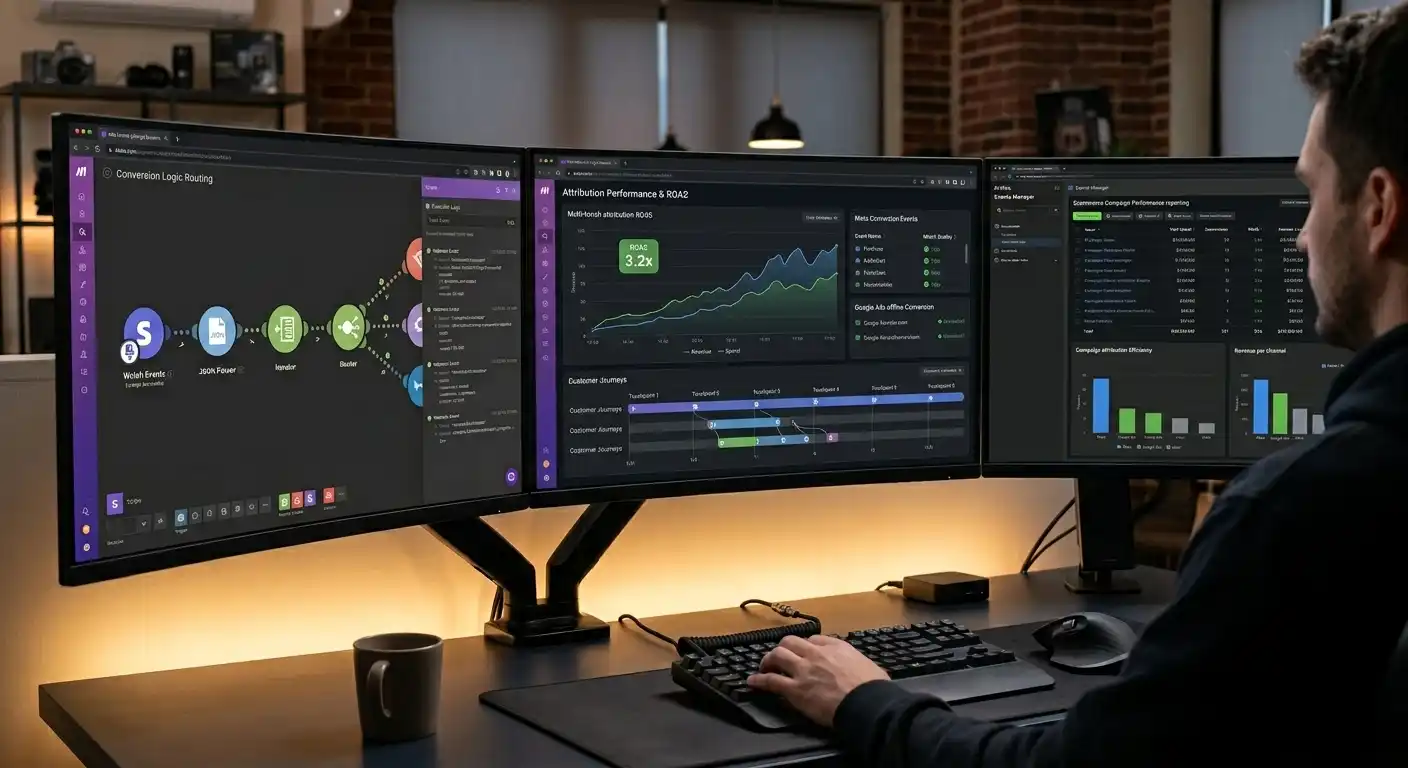
Why browser pixels alone aren’t enough
The standard Meta or Google pixel relies on a script running in the customer’s browser to report back when a conversion happens. Three things consistently break this: Safari’s Intelligent Tracking Prevention limits how long first-party cookies persist, ad blockers prevent the pixel script from loading at all for a meaningful share of visitors, and iOS privacy changes restrict cross-app tracking entirely.
The practical result is that ad platforms under-report conversions when relying on the pixel alone — and separately, each platform tends to over-claim credit for conversions it did influence, since Meta and Google both attribute the same sale to themselves independently. Neither problem is solved by switching ad platforms. Both are solved, partially, by adding server-side tracking: sending conversion data directly from your backend (Stripe, Shopify, your CRM) to the ad platform’s API, and by looking at blended ROAS — total revenue divided by total ad spend — as your source of truth rather than any single platform’s dashboard number.
Why attribution platforms fail even when installed correctly
None of the tools in this guide fix bad underlying data automatically. If your tracking setup has structural issues, any of these platforms will just report those issues more precisely. The most common causes:
- Broken UTM parameters. Multi-step funnels with redirects often drop URL parameters partway through, severing the link between the original ad click and the eventual purchase.
- Duplicate event firing. If a purchase event fires from both a browser pixel and a server-side API call without a shared deduplication key, the ad platform counts it twice — inflating reported conversions and skewing optimization.
- CRM and call-tracking latency. If offline conversions (a closed sales call, for example) are reported back to the ad platform after its attribution window has closed — commonly around 7 days — the algorithm can’t connect that conversion to the original ad, even if the data eventually arrives.
A platform like Hyros or Cometly can help structure data correctly from the start, but the underlying discipline — consistent UTMs, proper deduplication, fast CRM sync — matters regardless of which tool sits on top.
Pricing and difficulty at a glance
Pricing for attribution software is notoriously opaque — most of the options below are sales-led, meaning the number you’ll actually pay depends on a quote. The ranges here reflect publicly reported figures as of mid-2026.
| Platform | Typical pricing | Setup difficulty | Best for |
|---|---|---|---|
Hyros | Sales-led; published figures range roughly $200-800+/mo, scaling with tracked revenue | Medium-High — onboarding call typical | High-ticket, B2B, multi-touch funnels |
Triple Whale | Free tier available; paid plans roughly $130-450/mo by GMV tier | Easy — self-serve, connects to Shopify directly | Shopify DTC brands |
Cometly | Sales-led; published estimates vary widely, roughly $100-750+/mo depending on traffic volume | Easy-Medium — guided server-side setup | Cross-platform marketers wanting managed CAPI |
SegMetrics | Self-serve tiers; published estimates commonly start in the low hundreds per month | Medium — funnel and email-tool integration required | Course creators, info-product and webinar funnels |
Make.com (DIY)
Lowest cost | Roughly $9-30/mo in platform fees | Advanced — you build and maintain the logic | Technical teams, multi-brand operators |
Why these numbers are ranges, not prices
Hyros and Cometly don’t publish fixed price lists — both require a sales call, and pricing scales with your tracked revenue, ad spend, or site traffic. Triple Whale’s pricing is the most transparent and tier-based by GMV. If a specific number matters for your budget, get a current quote directly rather than relying on any published estimate, including this one.
Platform deep dives
Hyros — built for long, multi-touch funnels
Hyros’s core strength is tracking a single lead across a long journey: an ad click, several emails, a booked call, a follow-up call, and a close weeks or months later. It supports lookback windows long enough to connect that whole chain, plus call-tracking integration so phone-based conversions get attributed correctly. This is the exact shape of a coaching, consulting, or high-ticket B2B sales process — and a poor fit for a same-day-checkout Shopify store, where most of that machinery goes unused.
Choose Hyros if:
- Your sales cycle involves calls and spans weeks or months
- You need offline conversions tied back to ad clicks
- You’re comfortable with sales-led pricing and onboarding
Choose Triple Whale if:
- You run a Shopify store with same-day or short-cycle purchases
- You want creative-level ROAS without a sales call
- A free tier needs to prove value before you pay anything
Triple Whale — the Shopify-native dashboard
Triple Whale’s pixel and dashboard are built around Shopify’s order data from day one, which is why setup is largely self-serve — connect your store, connect your ad accounts, and the dashboard populates. The free tier is a real free tier, not a trial, which makes it a low-risk way to see whether first-party tracking changes your numbers before committing to a paid plan.
Cometly — managed server-side tracking with AI
Cometly’s pitch is removing the engineering work of server-side tracking — instead of you building the Conversions API integration, Cometly’s setup process handles event deduplication and routing to Meta, Google, and TikTok’s APIs for you, with AI-driven recommendations layered on top. The trade-off is that — like Hyros — getting an exact price requires a conversation with their sales team, and reported entry pricing varies considerably depending on your traffic volume.
Choose Cometly if:
- You want server-side tracking without building the API integration
- You advertise across multiple platforms, not just Meta
- AI-driven budget recommendations add value to your workflow
Choose Make.com DIY if:
- You’re comfortable configuring webhooks and API payloads
- You manage multiple brands and want one shared system
- Minimizing recurring software cost matters more than your time
SegMetrics — built for course and info-product funnels
None of the three platforms above were built with a course creator’s funnel in mind — webinar registrations, email nurture sequences, and a checkout that runs through ThriveCart, Stripe, or a Skool community rather than a Shopify cart. SegMetrics is. It connects to email marketing tools and webinar platforms directly, tracks a lead across that specific type of funnel, and reports attribution back in terms that match how info-product businesses actually sell — a meaningfully closer fit than forcing Hyros’s call-tracking model or Triple Whale’s Shopify assumptions onto a business that doesn’t run either.
Other names you’ll run into
Hyros, Triple Whale, Cometly, and SegMetrics cover the shapes of business this guide focuses on, but they’re not the only platforms in this category. A few others come up often enough in related searches that it’s worth knowing where they fit, even without a full deep dive.
Built for media buyers and affiliate marketers tracking clicks across multiple traffic sources and offers — closer to affiliate-network tracking than store or funnel attribution. Relevant if your business runs paid traffic to third-party offers rather than your own checkout.
A media-mix-modeling platform aimed at larger ecommerce brands with budgets that justify machine-learning attribution. Generally overkill below roughly six figures in monthly ad spend, and a reasonable next step above it.
A newer entrant marketing itself primarily against Cometly and Hyros, with accuracy claims published in its own comparison content. Worth evaluating if the platforms above don’t fit — verify any specific accuracy or pricing figures directly with the vendor rather than through a competitor’s summary of them, per the note earlier in this guide.
Setup friction worth knowing about upfront
What “server-side tracking” doesn’t fix automatically
- Event Match Quality (EMQ) still depends on your data. Sending a server-side event to Meta’s Conversions API only helps if the payload includes enough hashed customer identifiers (email, phone, and browser-side click identifiers like
fbc/fbp) for Meta to match it to a real user. A server-side event with no matching identifiers performs barely better than no event at all. - Click ID decay is a real constraint. Safari’s ITP limits how long link-decorated identifiers persist in first-party storage — often to around 24 hours. If your typical purchase happens days after the initial click, that identifier may already be gone unless it was captured and stored server-side at the time of the click. Hyros and Triple Whale both handle this server-side capture as part of their setup.
- Hyros’s onboarding is genuinely more involved. Between URL parameter configuration and a typical onboarding call, it’s a heavier lift than connecting a Shopify app — appropriate for the complexity it’s solving, but unnecessary if your funnel doesn’t need it.
- DIY maintenance is ongoing, not one-time. When Meta or Google change their Conversions API field requirements (which happens periodically), a managed platform updates its integration for you. A Make.com scenario you built yourself needs you to notice the change and update the payload mapping.
The DIY Make.com route
If you’d rather build the core logic yourself — intercept a Stripe webhook, hash the customer’s email, and post the conversion to Meta’s Conversions API — Make.com is the practical tool for it. The cost difference between Make.com and Zapier matters here specifically because attribution workflows tend to involve several steps per conversion: catching the webhook, formatting the data, hashing PII, and making the API call.
Why the automation platform choice matters for this use case
On Zapier, each of those four steps counts toward your monthly task allowance — a workflow that fires on every purchase can burn through a lower-tier plan quickly. On Make.com, the same four-step scenario consumes a small number of operations per run, and the Core plan’s 10,000 operations per month covers a meaningful volume of conversions for most small-to-mid businesses. See the full breakdown in Zapier vs Make.com.
[PARSE] Customer email extracted
[HASH] Email normalized and hashed (SHA-256)
[API] Posting conversion to Meta Conversions API…
[SUCCESS] HTTP 200 — event accepted
Considering the SaaS options instead?
If you’d rather not build and maintain this yourself, the managed platforms above handle the same logic with vendor support.
DIY attribution blueprint
The full Make.com scenario — Stripe webhook, SHA-256 hashing, and Meta Conversions API payload — is available as an importable blueprint if you want to build the DIY route described above.
Get the attribution blueprint →FAQ – Best Ad Tracking Software
Does Hyros work well for Shopify stores?
Hyros integrates with Shopify, but it’s built for long, multi-touch sales cycles involving calls and offline conversions — the kind of journey common in coaching and B2B. For straightforward Shopify DTC stores focused on creative-level ROAS, Triple Whale’s dashboard is built specifically for that use case and is generally a better fit.
Is Triple Whale or Hyros better for a Skool or course-based business?
Neither is built specifically for course creators. Hyros works if your funnel includes sales calls; Triple Whale is built for Shopify checkout, not community or course platforms like Skool. SegMetrics is built specifically for info-product and course funnels — webinars, email sequences, and Skool or ThriveCart checkouts — and is worth evaluating directly if that’s your primary business model.
Do you actually need server-side tracking in 2026?
For any meaningful ad spend, yes. Browser-based pixels lose data to ad blockers, Safari’s Intelligent Tracking Prevention, and iOS privacy restrictions. Server-side tracking sends conversion data directly from your backend (Stripe, Shopify) to the ad platform’s API, bypassing the browser entirely and capturing conversions the pixel would otherwise miss.
Is a DIY attribution setup with Make.com reliable?
Yes, for teams comfortable maintaining it. Make.com itself is a stable platform for routing webhooks and API calls. The risk isn’t the tool — it’s that when Meta or Google update their Conversions API requirements, your custom scenario needs updating too. A managed platform like Cometly or Triple Whale absorbs that maintenance for you; a DIY setup puts it on your team.
Which ad tracking software is easiest to set up?
Triple Whale’s free plan can be connected to Shopify in minutes with no sales call required. Cometly and Hyros are both sales-led — pricing and onboarding go through a demo call, and Hyros in particular involves more configuration around URL parameters and call tracking. A DIY Make.com setup has the steepest learning curve but the lowest ongoing cost.
How much does ad tracking software typically cost?
Triple Whale offers a free tier, with paid plans roughly in the $130-450/month range depending on your GMV tier. Hyros and Cometly are largely quote-based and scale with tracked revenue or ad spend — published estimates for Hyros commonly fall between $200 and $800/month for active advertisers, while Cometly’s entry pricing varies significantly by source. A DIY Make.com setup costs roughly $10-30/month in platform fees, plus your own time to build and maintain it. Always confirm current pricing directly with each vendor, as attribution software pricing changes frequently.
Should I trust comparison articles for ad tracking software?
Check the byline first. A meaningful share of ranking comparison content for this topic is published directly by one of the vendors under review, and those posts consistently rank their own product highest. That doesn’t automatically make the information wrong, but cross-check pricing and feature claims against each vendor’s own pricing page rather than relying on a competitor’s summary of it.
Disclosure: CreatorOpsMatrix is an independent automation publication. Links to Hyros, Triple Whale, Cometly, and Make.com on this page may be affiliate or partner links — if you sign up through them, we may earn a commission at no extra cost to you. Pricing figures are estimates compiled from publicly available sources as of mid-2026; attribution software pricing changes frequently and several of these vendors use sales-led, quote-based pricing. Confirm current rates directly with each vendor before making a purchasing decision.