Best Hyros Alternative 2026 for Server-Side Tracking
Last Updated: June 2026Can I build a Hyros alternative using Make.com?
Yes. The most cost-effective Hyros alternative using Make.com is a custom server-side conversion tracking pipeline. By intercepting Stripe or Shopify payment webhooks, normalising and SHA-256 hashing customer PII, and injecting the structured payload directly into the Facebook Conversions API, you get comparable attribution accuracy while eliminating $500 or more per month in SaaS tracking fees.
Our Pick: Make.com as the Hyros Alternative
Full server-side CAPI routing for $9–$50/month. Free tier covers most early-stage builds.
Table of Contents
1. The $500/Month Tracking Tax and Pixel Death
⚠️ Every day you rely solely on browser pixels, you are feeding incomplete conversion data to your ad algorithms.
Following Apple’s Intelligent Tracking Prevention rollout and the deprecation of third-party cookies across major browsers, browser-based tracking routinely drops between 30% and 40% of conversion events before they reach Meta or Google. Dedicated tracking tools like Hyros solve this by establishing direct server-to-server connections that bypass the browser entirely — but at a monthly cost that can exceed what many operators spend on the ads themselves.
The problem goes beyond inaccurate reporting. Meta’s ad delivery algorithm uses conversion signals to optimise audience targeting and bid strategy. When your pixel drops 35% of purchase events, the algorithm learns from a dataset where roughly one third of your real customers are invisible. It over-bids on audiences that look like your visible converters while ignoring the segments responsible for a third of your actual revenue. The ROAS figure in Ads Manager inflates. Real margins compress. The attribution error corrupts the entire optimisation loop, not just the dashboard.
According to Meta’s Conversions API documentation, server-side events sent via CAPI consistently outperform browser-only pixel setups in Event Match Quality scoring and conversion attribution rates. The reason is straightforward: server events originate from a trusted environment rather than a user’s browser, which means ad blockers, ITP, and cookie deletion cannot interfere with the transmission.
2. Why Hyros Costs What It Costs
Hyros is not just a server-side tracking tool. It is a managed attribution platform providing multi-touch journey mapping across ad platforms, AI-powered attribution modelling, a dedicated onboarding team, and an interface that aggregates conversion data from multiple traffic sources into a single dashboard. The monthly cost reflects the engineering overhead of maintaining those proprietary models and the infrastructure required to process high transaction volumes reliably.
For operators scaling past $100,000 per month in ad spend who need multi-touch attribution across Meta, Google, YouTube, and email simultaneously, Hyros delivers measurable value that justifies the cost. The platform’s attribution modelling identifies which touchpoints in a multi-step customer journey contributed to a conversion — a capability that a custom Make.com webhook pipeline does not replicate natively.
For operators spending between $5,000 and $50,000 per month on a single primary ad platform — typically Meta — the core requirement is different. They need verified purchase events reaching the Meta Graph API with accurate customer identifiers and click IDs attached. That specific requirement is fully achievable with a custom Make.com pipeline at a fraction of the cost, without the multi-touch modelling overhead.
The functional overlap: Both Hyros and a Make.com CAPI pipeline intercept payment events, extract customer identifiers, and transmit server-side conversion signals to ad platforms. Hyros wraps this in a managed dashboard, multi-platform attribution modelling, and dedicated support. The Make.com build delivers the transmission layer — which is the most impactful component for most single-platform advertisers.
3. Hyros vs Make.com Attribution: Full Comparison
Make.com DIY Attribution — Advantages
- Costs between $9 and $50 per month at any practical volume
- Full ownership of first-party data — stored in Airtable or Google Sheets
- No revenue-based pricing tiers or long-term SaaS contracts
- Direct integration with any custom webhook source including Stripe, Shopify, and GoHighLevel
- Full visibility into exactly what data is transmitted and when
Make.com DIY Attribution — Limitations
- Requires understanding of JSON structures and API routing logic
- No dedicated dashboard — reporting lives in your data warehouse
- You are responsible for updating the logic if Meta’s API schema changes
- No multi-touch attribution modelling across multiple ad platforms
- No dedicated support — debugging requires internal technical capacity
| Tracking Tool | Monthly Cost | Attribution Recovery | Multi-Touch Modelling | Setup Complexity |
|---|---|---|---|---|
| Hyros | $200 — $4,000+ | High — Server-Side | Yes — AI Modelling | Easy — Onboarding Rep |
| Make.com (DIY) | $9 — $50 | High — Server-Side | No | Advanced — API Logic |
| Cometly | $99+ | High — Server-Side | Partial | Medium |
| TripleWhale | $129+ | High — Shopify Native | Yes | Medium |
| Browser Pixel Only | Free | Low — 30–40% data loss | No | Easy |
Make.com handles the core job for a fraction of the cost
Server-side CAPI routing for single-platform Meta advertisers — $9/month on Core.
4. How to Replace Hyros with Server-Side Tracking
Server-side tracking via Make.com works by intercepting your payment processor’s webhook at the moment a transaction completes. The key insight is that your payment processor — Stripe, Shopify, GoHighLevel — already knows a verified sale occurred. That verified event is the most reliable conversion signal available. Routing it to Meta’s Graph API server-to-server, with the customer’s click ID and hashed PII attached, produces an attribution signal that is both more accurate and more tamper-resistant than anything a browser pixel can transmit.
1. Browser Pixels Only
Blocked by iOS ITP and ad blockers. Drops 30–40% of conversion data. Inflates reported CPA by misattributing or missing real purchases.
2. Managed SaaS — Hyros
Resilient server-side tracking with multi-touch modelling and a managed dashboard. Accurate but introduces $200 to $4,000+ monthly overhead.
3. Make.com API Bridge
Server-side accuracy matching Hyros for single-platform advertisers. Full first-party data ownership. Costs $9 to $50 per month.
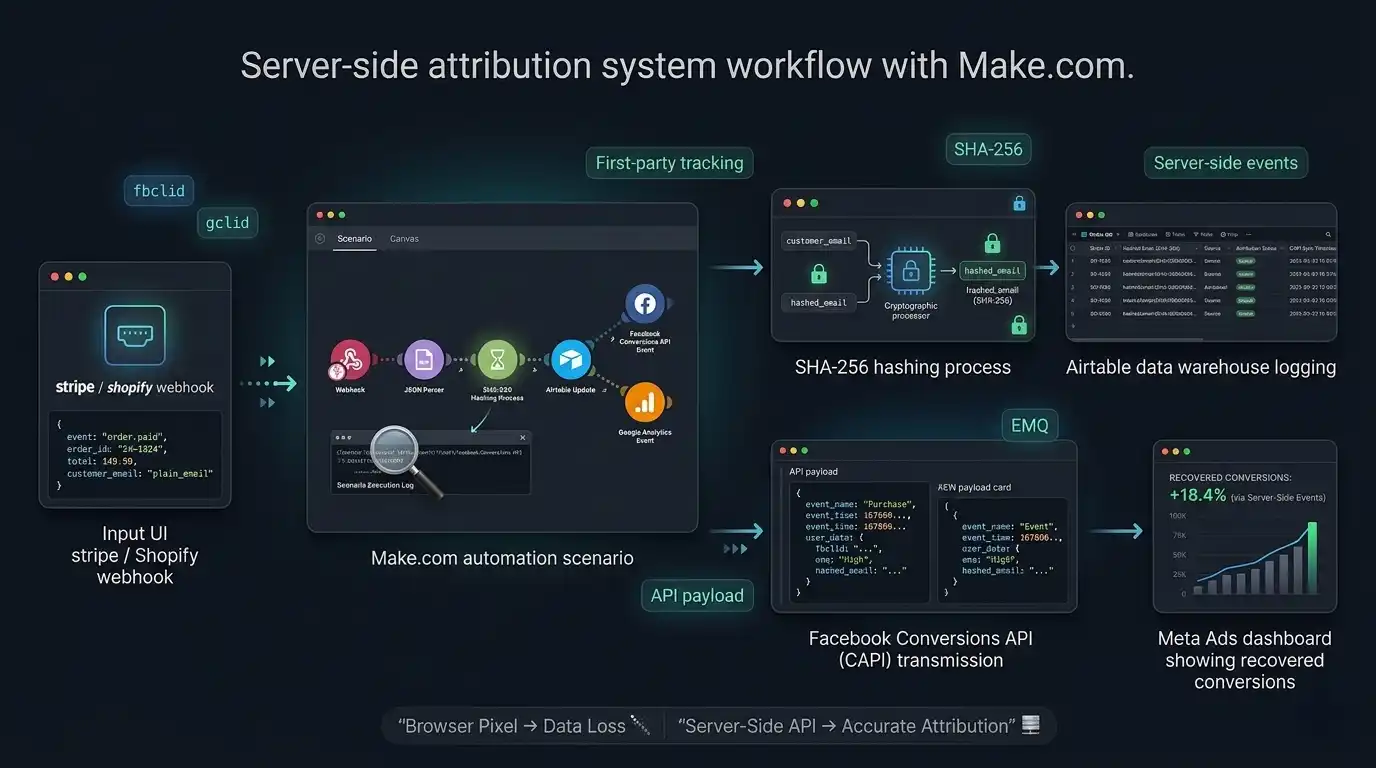
Make.com scenario routing Stripe payment webhooks through SHA-256 PII hashing to the Meta Conversions API endpoint.
Step 1: Intercept Transaction Webhooks
Configure a Make.com custom webhook as the receiving endpoint for your payment processor’s transaction events. In Stripe, navigate to the Developers section and add a new webhook endpoint pointing to your Make.com webhook URL. Set it to listen exclusively for the charge.succeeded event. This guarantees that only verified, completed sales trigger your attribution engine — preventing false conversion signals from failed payments or checkout initiations that did not complete.
Step 2: Parse and Hash Customer PII
The incoming Stripe webhook payload contains the transaction amount, customer email, and any metadata you have configured to pass through checkout — including the fbclid click ID if you are capturing it at the landing page level. Extract the email address and normalise before hashing: lowercase the string, strip leading and trailing whitespace, then apply SHA-256 using Make.com’s built-in cryptographic functions. The fbclid must be formatted as fb.1.UNIX_TIMESTAMP.FBCLID_VALUE to satisfy Meta’s fbc parameter requirements. Full normalisation sequence is documented in our Facebook CAPI match quality guide.
Step 3: First-Party Data Warehousing
Before routing to the ad platform API, log the full transaction record to Airtable or Google Sheets. This is your organisation’s first-party data repository — immune to pixel degradation, 24-hour click ID decay, and platform policy changes. Each record should contain the Stripe charge ID, order value, customer email hash, click ID, timestamp, and the product purchased. This dataset becomes your source of truth for manual attribution auditing and can rebuild historical attribution if an API connection ever fails.
Step 4: Server-Side API Transmission — Meta CAPI
Add an HTTP module configured as a POST request to https://graph.facebook.com/v19.0/{PIXEL_ID}/events?access_token=YOUR_ACCESS_TOKEN. The JSON payload must include event_name set to Purchase, event_time as a Unix timestamp, action_source set to website, the hashed em email field, the fbc click ID, and the custom_data object with value and currency. Include the event_id matching whatever ID your browser pixel fired for the same conversion to enable proper CAPI deduplication.
[SYSTEM] Charge ID: ch_3Pxxxxxxxxxxxxx | Value: $997.00 | Currency: USD
[PARSER] Extracted fbclid from metadata: IwAR2_xx…
[PARSER] Formatting fbc: fb.1.1715000000.IwAR2_xx…
[ENCRYPTION] Normalising email: customer@example.com → customer@example.com
[ENCRYPTION] SHA-256 Hash: a1b2c3d4e5f6…
[WAREHOUSE] Appending row to Airtable: order_20260508_4421
[API_POST] Transmitting to graph.facebook.com/v19.0/{pixel_id}/events
[SUCCESS] HTTP 200 OK. Events received: 1. Matched: 1.
5. The Required Infrastructure Stack
1. The Routing Engine: Make.com
The central logic layer. Catches Stripe webhooks, runs SHA-256 hashing, formats the Meta API payload, and fires the server-side conversion event. The Core plan at $9/month handles the operation volume for most campaigns. The Pro plan at $16/month covers high-volume operations above 10,000 monthly transactions. Remember to use webhook triggers — not polling — or you will burn through operations unnecessarily.
2. The Data Warehouse: Airtable
Acts as the primary first-party data repository for all transaction records, click IDs, and attribution metadata. Provides a queryable interface for manual attribution auditing and integrates directly with Make.com via native module. Airtable’s free tier handles up to 1,000 records per base before requiring a paid plan.
📈 What Server-Side Attribution Recovers
Operators running browser-pixel-only tracking on audiences with high ad blocker penetration — developer and SaaS audiences in particular — typically see the largest recovery gains when switching to a CAPI pipeline. The recovery rate scales with how privacy-conscious the target audience is. Audiences on iOS devices and those using privacy-focused browsers show the most missing conversion events under pixel-only tracking. The actual recovery range varies by campaign configuration, audience geography, and the quality of click ID capture at the landing page level. Verify your specific recovery by running CAPI alongside your pixel for 14 days and comparing event counts in Meta’s Events Manager.
6. Which Option Should You Choose?
The right attribution infrastructure depends on three variables: your monthly ad spend, the number of platforms you are actively running paid traffic on, and your team’s technical capacity to build and maintain API routing logic.
DIY Make.com Pipeline
Best for operators spending $5k–$80k per month on a single primary ad platform who have the technical capacity to configure JSON routing. Delivers equivalent server-side attribution accuracy at 5–10% of the Hyros cost.
Deploy Make.com →Mid-Tier Managed — Cometly
Best for operators who want server-side tracking without API configuration. Handles the Graph API connection and provides a reporting dashboard at $99/month — significantly cheaper than Hyros with comparable core functionality.
Deploy Cometly →Enterprise — Keep Hyros
Best for operators spending above $100k per month across multiple ad platforms who need multi-touch attribution modelling, journey mapping, and dedicated support to optimise complex cross-platform campaign structures.
Evaluate HyrosDon’t Want to Build It From Scratch?
If managing the Meta Graph API directly is outside your current technical capacity, Cometly provides the same server-side conversion transmission in a managed interface. You connect your pixel and payment processor — Cometly handles the API routing without requiring JSON configuration or webhook management.
Deploy Your Own Attribution Engine
Access the complete Make.com scenario file for the Stripe to Meta CAPI attribution pipeline. Import it in one click, add your Stripe webhook URL and Meta pixel access token, and the server-side conversion routing is live immediately.
Download the DIY Attribution Blueprint (.JSON) →Related Attribution Guides
7. Frequently Asked Questions
Yes. A production-grade server-side attribution system using Make.com intercepts payment webhooks from Stripe or Shopify, extracts click identifiers, normalises and SHA-256 hashes customer PII, and routes the structured payload directly to the Meta Conversions API. The total monthly cost runs between $9 and $50 depending on transaction volume — delivering equivalent attribution accuracy for single-platform advertisers at a fraction of the Hyros cost.
Browser pixels fire JavaScript events from the user’s device. Apple’s Intelligent Tracking Prevention, Safari’s cookie deletion policies, and widespread ad blocker adoption silently drop between 30% and 40% of conversion events before they reach Meta or Google. The ad platform never receives those events, the algorithm learns from an incomplete dataset, and the ROAS figure in Ads Manager inflates relative to actual revenue. Server-side tracking bypasses the browser entirely, transmitting conversion signals directly from your server to the ad network.
Hyros pricing ranges from approximately $200/month at entry level to over $4,000/month at high revenue volumes, with costs scaling based on tracked revenue thresholds. A custom Make.com attribution pipeline handling the same server-side conversion routing costs between $9 and $50/month depending on transaction volume. Migrating from a standard Hyros plan at $500/month to a Make.com build at $30/month saves approximately $5,640 per year without any reduction in server-side attribution accuracy for single-platform campaigns.
The three strongest mid-tier alternatives are Cometly at $99/month for managed server-side tracking with a reporting dashboard, TripleWhale starting at $129/month for Shopify-native multi-touch attribution, and a custom Make.com pipeline for technically capable operators at $9–$50/month. For single-platform Meta advertisers with internal technical capacity, the Make.com build delivers equivalent core functionality at the lowest cost. For teams wanting a managed interface without API configuration, Cometly is the strongest mid-tier option.
Yes. The same webhook interception and PII hashing logic works for both Meta’s Conversions API and Google’s Enhanced Conversions API. You extract the gclid parameter from the transaction metadata for Google routing and the fbclid parameter for Meta routing. A single Make.com scenario with a Router module can simultaneously fire to both ad networks from one payment webhook trigger, handling both attribution channels from one pipeline execution.
The fbclid parameter is appended to your landing page URL when a visitor arrives from a Meta ad. Capture it in your checkout flow — store it in a session variable, pass it as a hidden form field through checkout, or append it as metadata to the Stripe payment intent. When the charge.succeeded webhook fires, the fbclid is available in the metadata. In Make.com, extract it and format it as the fbc field: fb.1.UNIX_TIMESTAMP.FBCLID_VALUE before including it in the CAPI payload.
Hyros is a managed attribution platform providing multi-touch journey mapping across ad platforms, AI attribution modelling that assigns credit across multiple touchpoints, a dedicated reporting dashboard, and onboarding support. A Make.com pipeline performs the server-side conversion transmission layer — intercepting payment events and routing them to ad platform APIs — without the multi-touch modelling or managed interface. Hyros is the correct choice for operators running complex cross-platform campaigns above $100k/month in ad spend. Make.com is the correct choice for single-platform advertisers who need server-side accuracy without managed platform overhead.